This is how I win many of my games. 1.u32.l173.p164.p19 This me setting a trap. 5.q18 This is my opponent walking into my trap, There are two things you should do with every opening move. 1. Block my plans. 2. While you're doing that, try to generate new threats of your own. White's Q18 does the first (locally) but not the second. Instead, |5.j17 looks much better. Consider the game position after black O10. Do you see a way to stop this peg from connecting to the right wall? I sure don't. Do you see a way to block O10 from connecting to the left wall? I sure don't.
On
2026-01-08 at 14:49,
Alan Hensel
said:
I agree with everything David just said. I'd just like to add:
|7.r20 is not something I would have even thought of. It guarantees the connection to the bottom, but doesn't help connect to the top.
My first thought would be |7.s19, which still guarantees the connection to the bottom, but it helps the connection to the top. In this case, it actually catches the ladder chase from David's O10 peg: 8.o109.s1010.r1311.r1212.p1213.s1414.s1515.t1616.t1717.u18 - I hesitate to say it makes O10 flat out not work, but gives Black a tougher challenge.
Then I'd try to find something with an even lighter touch to the near border that helps the connection to the top more. Just rotating the link one unit, maybe |7.s17? 8.r209.v2010.t2011.t2112.s2213.u1814.u2315.w22 -- looks like it can connect to the bottom.
Then maybe consider disconnected pegs like |7.t17 - there is danger in leaving that gap, but White has its back against the wall and needs the strongest connection to the top that he can possibly muster. I don't actually like this one so much after 8.r189.v1810.s16.
On
2026-01-12 at 02:35,
MCx
said:
Interesting and instructive comments, guys. David, you made a similar comment to me back in another game - regarding 5.q18 being only a local block, and apparently you won by basically ignoring that distraction and playing 8.o10 in the middle. But you did that on move 8. Could you have not played the same move on move 6? ie. |6. o10.
On
2026-01-21 at 15:12,
Peyrol
said:
Alan, yes |7.s19 was better, in which case maybe I would have played 8.p9 and this would have been more difficult for me but IMO still winning. |7.s17 might be a bit too loose after 8.r209.v2010.o1011.s1012.r1313.r1214.u18
MC that's a good question. I was playing the opponent instead of the position, trying to tempt him into making another bad move, to make my job even easier. And it worked. Objectively I don't know which choice is better. After |6.o10 suppose white then plays 7.s19 This threatens white S10 as Alan showed. It would be too late for me to try 8.k19, instead I would probably extend upward from O10, maybe 8.o6 It still looks good for me, but I would have had to work harder in this unfamiliar position. The answer is, I was too lazy.


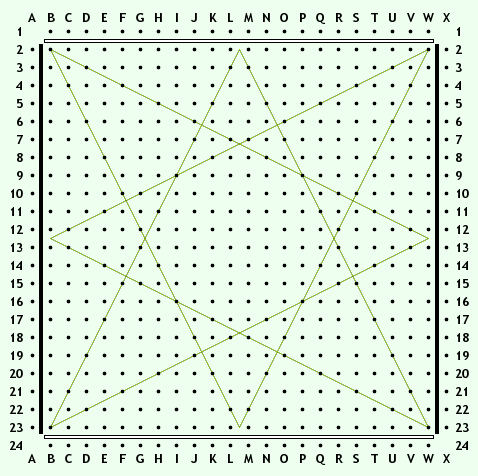


1.u3 2.l17 3.p16 4.p19 This me setting a trap.
5.q18 This is my opponent walking into my trap,
There are two things you should do with every opening move.
1. Block my plans.
2. While you're doing that, try to generate new threats of your own.
White's Q18 does the first (locally) but not the second. Instead, |5.j17 looks much better.
Consider the game position after black O10. Do you see a way to stop this peg from connecting to the right wall? I sure don't. Do you see a way to block O10 from connecting to the left wall? I sure don't.
|7.r20 is not something I would have even thought of. It guarantees the connection to the bottom, but doesn't help connect to the top.
My first thought would be |7.s19, which still guarantees the connection to the bottom, but it helps the connection to the top. In this case, it actually catches the ladder chase from David's O10 peg: 8.o10 9.s10 10.r13 11.r12 12.p12 13.s14 14.s15 15.t16 16.t17 17.u18 - I hesitate to say it makes O10 flat out not work, but gives Black a tougher challenge.
Then I'd try to find something with an even lighter touch to the near border that helps the connection to the top more. Just rotating the link one unit, maybe |7.s17? 8.r20 9.v20 10.t20 11.t21 12.s22 13.u18 14.u23 15.w22 -- looks like it can connect to the bottom.
Then maybe consider disconnected pegs like |7.t17 - there is danger in leaving that gap, but White has its back against the wall and needs the strongest connection to the top that he can possibly muster. I don't actually like this one so much after 8.r18 9.v18 10.s16.
MC that's a good question. I was playing the opponent instead of the position, trying to tempt him into making another bad move, to make my job even easier. And it worked. Objectively I don't know which choice is better. After |6.o10 suppose white then plays 7.s19 This threatens white S10 as Alan showed. It would be too late for me to try 8.k19, instead I would probably extend upward from O10, maybe 8.o6 It still looks good for me, but I would have had to work harder in this unfamiliar position. The answer is, I was too lazy.